 Skip to content
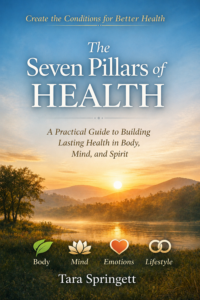
This is the introduction to The Seven Pillars of Health by Tara Springett.
 The world is becoming sicker with many chronic diseases increasing at an unprecedented rate. Autoimmune diseases are on the rise, with coeliac disease, Sjogren’s syndrome, and Graves’ disease all more than doubling in the last twenty years in the UK. Equally shocking is the fact that the prevalence of people living with diabetes in the UK has also doubled in roughly the same time period. The number of people living with dementia has risen by almost 50% in the same short time span of only twenty years. Even in younger people, cancer rates have increased by a staggering 79 per cent worldwide in the last 30 years. In addition, recent studies have shown that burnout is at an all-time high. In the USA, a recent study found that 82% of employees exhibit symptoms of burnout, and are at risk of developing the full-blown disease, a dramatic increase from 52% just five years earlier. (1-5)

I have seen the trend of people getting sicker in my counselling practice, too. Among my clients seeking counselling, requests for getting help for many physical ailments have become much more commonplace during the last ten to twenty years, and particularly after the COVID-19 pandemic. Obviously, I always sent everybody to their doctor for a check-up, but in many cases, there wasn`t much these health practitioners could do for my clients’ health problems. For this reason, I have decided to write this book to show how I have helped myself and numerous clients reduce, and in many cases eliminate, many illnesses and ailments by following and implementing the seven pillars of health. I can truthfully say that every single client who put the seven pillars of health into action has significantly improved their physical symptoms or completely eradicated them. These conditions included severe pain syndrome, digestive disorders, hypothyroidism, colitis, chronic fatigue, and chronic high blood pressure, among many others. I also had some clients with a diagnosis of serious disease, such as multiple sclerosis, Parkinson’s, and Morbus Crohn and rheumatic arthritis, who were more or less free of symptoms. In addition, my clients reduced or eliminated psychological symptoms like depression, anxiety, and anger, and became much happier. It is my hope that you, too, can learn and implement these pillars and achieve similar improvements.
The seven pillars of health can be easily learnt from this book, and do not cost anything beyond its purchase. You will have to practice a few simple exercises for your mind and body that will take no more than one hour a day. You probably will have to change your diet, too. Even if you practise for less than an hour a day, you may still reap many health benefits. The good news is that these principles work, even if you are sceptical. The main message of this book is that there are many things you can do to increase your chances of healing by taking responsibility for your health and implementing healthy nutrition and a few gentle feel-good exercises into your day. The wisdom and knowledge that underpins the seven pillars of health are drawn from several different sources:
As a Tibetan Buddhist teacher, I use Buddhist understanding to come to terms with the apparent randomness and unfairness when a sudden or chronic illness befalls us, and how we can focus our mind to come back to an attitude of equanimity and calm that is so important for healing to take place. I also know about the power of our mind to increase the placebo effect, and thereby make healing more likely. Moreover, we will be using wisdom about the chakras to contribute to healing (pillars one and four).
Qigong theory, Buddhism, and Western Psychotherapy all agree that our negative emotions – like anger, depression, and anxiety – play a far bigger role in the development and duration of our illnesses than is commonly perceived. In this book, I will explain how negative emotions can cause disease, and how to dissolve them in a simple, straightforward way without repressing them again (pillars one and two).
As a psychotherapist, I also understand that certain relationship behaviours increase the likelihood of physical disease, and how to let go of these negative patterns (pillar three). In addition, I will explain how an unconscious dynamic of receiving hidden benefits from being sick can hinder our recovery, and how to let go of this (pillar seven).
Evidence-based nutrition informs us on how to use diet to improve the state of our emotions and our bodies. Unfortunately, no amount of meditation, psychotherapy, and qigong will make us healthy, so long as we continue to eat sickness-inducing foods (pillar five).
As a qigong teacher, I draw heavily on my understanding of qigong theory and traditional Chinese medicine, including how to use our minds in combination with gentle movements to restore our energy body to the healthy pattern nature intended (pillar six).
The entire book is underpinned by the Ayurvedic understanding of five interpenetrating bodies of increasing subtlety, and offers techniques to influence each of these bodies for optimal health (all pillars).
As you can see, the seven pillars of health encompass quite disparate approaches from very different healing traditions around the world: from Western psychotherapeutic understanding of psychosomatic dynamics to Chinese qigong, and from evidence-based nutrition to enhancing the placebo effect through meditative exercises. It is the combination of these approaches that sets this book apart from others on healing. So, instead of focusing on just one healing modality, we are combining different approaches from around the world that we can all do ourselves in the comfort of our own home, at no cost, and within just a single hour of practice a day.
All the meditative exercises in this book are based on Tibetan Buddhism, which contains thousands of years of accumulated wisdom from a large community of sincere spiritual practitioners. These meditations are simplified and tailor-made for the purpose of helping us calm our minds in the context of chronic disease. I removed all Tibetan Buddhist jargon to make these meditations suitable for a wider audience from many different backgrounds, as well as for people who consider themselves non-spiritual. These meditations are very safe and have never brought up anything like a healing crisis, where things get worse before they get better. For that reason, it is not possible to overdo them or do them incorrectly. Every meditation you attempt is a success, regardless of how distracted you were or if you worried about doing things wrongly. When you approach the meditations with a playful and light-hearted attitude, they will work even better.
My own story
A number of years ago, in my middle age, I suffered from quite a few ailments and physical problems. These were hypothyroidism, anaemia, low blood sugar, angina, chronic cough, chronic gastritis, shoulder pain, back pain, hip pain, hot flushes, and extremely high cholesterol despite eating a very healthy, vegetarian diet (or so I thought). The worst of all my symptoms was extreme tinnitus. I went to a great number of practitioners, both from mainstream medicine and from complementary approaches, but none of them could decrease my suffering or give me help with any of these symptoms. This meant that I had to sort all these problems out by myself, which I did at first quite haphazardly, and through endless experiments. As time went on and due to the requests of my clients to help them with their health problems, I distilled and perfected the seven pillars of health.
After implementing the seven pillars of health as described in this book, I can truthfully say that all my symptoms have disappeared and that both my husband, aged 70, and I, aged 64, are healthier than we have ever been in our adult lives. My husband`s high cholesterol and elevated blood pressure are back in the healthy ranges, his frequent colds and bronchitis are long a thing of the past, and neither of us takes any medications. We both don`t even need reading glasses or hearing aids, which is highly unusual at our ages. My own thyroid values are normal again, and the chronic cough and gastritis disappeared long ago. There is enough iron in my blood, and my low blood sugar has disappeared along with all the aches, pains, and hot flushes. My cholesterol is now so low that I am in the zone that is considered “heart-disease proof.” I can go jogging again without any angina pain in my chest – even uphill. Best of all, the tinnitus has virtually disappeared. Nigel and I had tried a number of modalities in earlier years to achieve better health, but nothing had made a significant difference. So, we attribute all these improvements entirely to the seven pillars of health.
Nevertheless, through a minor injury that became infected, I recently suffered from a severe case of sepsis, which is a serious disease that can be life-threatening. Of course, I went to the hospital as instructed, where I had to stay for eight days. I received intravenous antibiotics and morphine to treat the extreme pain I experienced. According to the website of the National Health Service in the UK, most people take months and, in some cases, even years to fully recover from sepsis, especially when they are older, like me. In my case, due to the implementation of the seven pillars of health, it took me exactly 11 days from my diagnosis until I was back to my regular work schedule, and about one month until I was back on my full exercise regimen. And that was despite the fact that I did not have a light case of sepsis; my inflammation markers were extremely high! I also did not suffer in the slightest from the so-called post-sepsis syndrome, which includes weakness, fatigue, and post-traumatic stress syndrome with increased negative emotions. The doctors and nurses who looked after me expressed surprise and praised my rapid recovery.
The following case study describes one of my clients who recovered from debilitating chronic fatigue syndrome. He is one of many clients who recovered from this condition while working with me:
Case study: Robert (24)
Robert was diagnosed with depression at the age of 14 and had to spend four months in a psychiatric hospital. Even though he was highly intelligent and had previously earned good grades, his academic performance declined sharply after returning to school. He left school with minimal qualifications and tried various apprenticeships, all of which he had to give up after a short while. When we met, he lived by himself, unable to work due to chronic fatigue syndrome and depression, and he did not know what to do with his life. His parents financed him.
Robert had participated for years in psychotherapy, which encouraged him to look for faults in the way his parents had brought him up, implying that his condition was due to some sort of childhood trauma or parental neglect. But the truth was, Robert had no significant childhood trauma, and his parents had not been neglectful. In fact, his parents were rather well-meaning, educated, and had tried a great deal to help their depressed and sick son. I told Robert that the focus on what his parents had done wrong induced a victim mentality and anger in him, and that it was this anger that made his condition worse. This was completely new for Robert, and it took a few sessions before he could take this new perspective on board.
I then showed Robert how to meditate on love and joy and how to forgive his parents. I also showed him how to change his diet. From then on, his condition improved rapidly. With my encouragement, he started working two days a week, and a few months later, he enrolled in a school to gain the qualifications to attend university. So far, after a year at his school, he has only received the best grades, and the crippling fatigue that had held him back for so many years has completely disappeared. In addition, his depression has virtually disappeared, and instead, Robert enjoys much joy on a daily basis.
How to use this book
The pillars of health are arranged so that they build on one another. Ideally, you would work through them in the order they are presented. At the end of each chapter, you will find a short action plan for the exercises that were presented in that chapter. These exercises will slowly build up with each chapter, but will never take longer than 60 minutes a day. Do not worry if you cannot do all the exercises. Just do what you can and what feels good to you, and that will be good enough. Please also use common sense when using my advice, and adapt it to your own unique situation.
I recommend that you start implementing the advice in this book slowly, bit by bit, and not put pressure on yourself to do it all at once. Stress should be avoided at all times, so please proceed slowly. For that reason, it is best to start with the recommendations that are most appealing to you and that are the easiest for you to implement. If you are lucky, this is all you need to recover from your current ailment.
As time goes by, you may then feel more motivated to tackle the other pillars that do not come so easily to you. It is completely okay if this process takes many months or even years. As a rule of thumb, you should expect to use more of the pillars as you get older. The seven pillars of health are not just there to overcome disease but also the perfect anti-ageing modality.
But I also want to emphasise that the seven pillars are not meant to replace traditional Western medicine. When it is necessary to take prescription drugs or to have surgery, the principles of this book will support these treatments, speed up recovery, and ensure that you can tolerate medications better and with fewer side effects. On the basis of the seven pillars of health, you will also find that simple home remedies like chamomile tea for stomach ache, arnica cream for joint pain, and raw garlic as a mild antibiotic work astonishingly well.
The main message of this book is that health and illness are not a lottery in which some people have good luck while others do not. The vast majority of diseases can be prevented, improved, or even completely eradicated with relatively simple interventions. Good health is therefore not a mystery but a predictable state that depends on a number of conditions largely under our control and that do not require any money or much effort.
Scientific proof
For most of the claims I make in this book, I can provide ample scientific evidence and point to world-renowned experts. However, due to my reliance on pre-scientific medicinal modalities such as Tibetan Buddhism and qigong, this was not always possible to the degree I would have liked.
NOTES
[1] Conrad, N., Misra, S., Verbakel, J. Y., Verbeke, G., Molenberghs, G., Taylor, P.N., Mason, J., Sattar, N., McMurray, J. J. V., McInnes, I. B., Khunti, K., and Cambridge, G. (2023). Incidence, prevalence, and co-occurrence of autoimmune disorders over time and by age, sex, and socioeconomic status: a population-based cohort study of 22 million individuals in the UK. The Lancet. 401(10391):1878–1890. doi:10.1016/S0140-6736(23)00457-9
[2] Currie, C. J., Currie, J. G., Holden, S. E., Morgan, C. L., Heywood, B. R., Peters, J. R., & the Livingstone Development Team. (2024). The descriptive epidemiology of type 2 diabetes in the United Kingdom from 2004 to 2021. medRxiv. https://doi.org/10.1101/2024.03.04.24303693
[3] Prince, M., Knapp, M., Guerchet, M., McCrone, P., Prina, M., Comas-Herrera, A., Wittenberg, R., Adelaja, B., Hu, B., King, D., Rehill, A., and Salimkumar, D. (2014). Dementia UK: Update (Second Edition). Alzheimer’s Society, London.
[4] Sun, L., et al. (2023). Global trends in incidence, death, burden and risk factors of early-onset cancer from 1990 to 2019: a population-based study. BMJ Oncology, 2[1]: e000049. doi:10.1136/bmjonc-2023-000049
[5] The State of Workplace Burnout in 2025: A Comprehensive Analysis. The Interview Guys, July 16, 2025. Available at: blog.theinterviewguys.com/workplace-burnout-in-2025-research-report/
To buy the book click here
 Deutsch
